Monday, August 8, 2011

The Grand Buddha of Shilshole


What I tried to do for this project was to select historical references from different times as well as cultures, as well as symbolic meaning. I started with the beginning where the first sculptures from early Cycladic societies represent little more than the statement that they existed. The nomadic peoples of ice-age Europe idealized the feminine form (Venus of Willendorf.) Later, the Egyptians codified symbols into meaningful artforms that went unchanged for roughly three thousand years. The statue of Ramesses II represents a specific man and the symbols associated with him allowed the people of that culture to understand that he was a King, a God, a great warlord of many deeds, etc. etc. The Greek and Roman cultures used gods as allegories to represent not just the might of individuals but of their city-states. Nike was built to stand for the victorious navy of Samothrace and so glorified everyone in that town.
Now I'm going East, to other cultures that existed during these ages but had no contact with the previous societies I've borrowed from. I think it interesting that the highly sophisticated Nike was created a few hundred years before the common era, and the Great Buddha of Leshan, (although still impressive is quite simplified) was made between six and nine hundred years after. It was being built around the same time as Europe was entering the Middle Ages from which I do not have a significant source of sculptural material to draw upon.
But back to Buddha: although I wanted to stay away from religious icons, I couldn't help choosing to replicate this. It is not just the figurehead of a religion, but like Nike, it represents a virtue. Unlike Nike or anything else I've shown so far, it is not about self glorification or military prowess, it is a testement to the higher ideals of philosophy and peaceful living which the Chinese of this time chose to carve into their mountain.

Wednesday, August 3, 2011

My Nike


check it out- i was photographed by the AP!
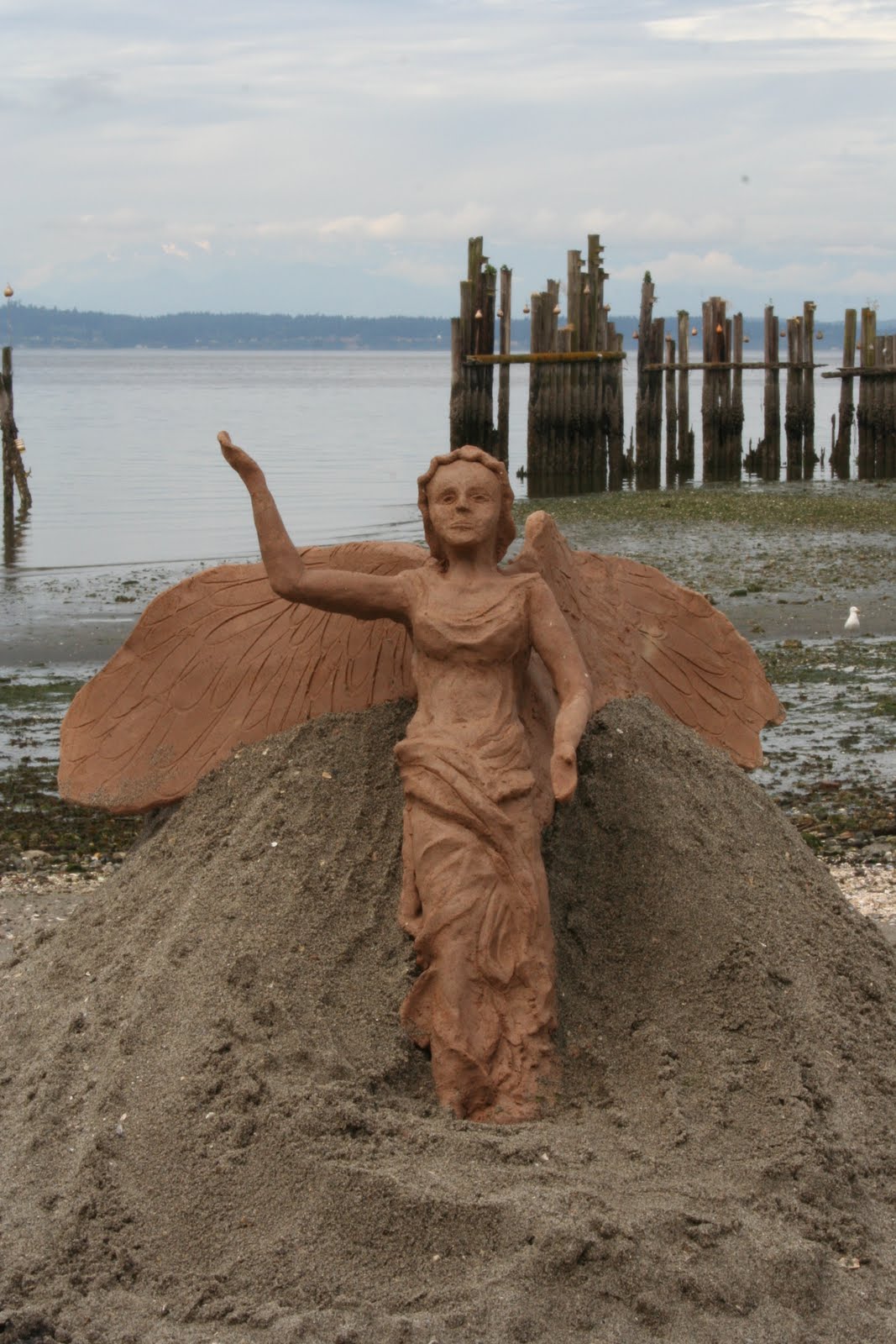
Anyway, I finally got around to finishing Nike of Samothrace. She was a difficult one with all of her wings and arms just hanging out there. I had to build most of her parts separately beforehand and allow them to dry before assembling at the beach, otherwise it would not have worked.
She must be one of my all-time favorite sculptures in history. You can see a better study of her form in an earlier post when I was applying for this exhibition. At that time I was hoping to be able to make these sculptures as large as any person, but I'm glad now I have to make do with the amount of clay I have! It's good practice for future endevors, but man is it a lot of work!
Here I have interpreted how she must have looked before loosing her arms and wings, although I think I like what time and archeology have done to the original statue. This is a fabulous site from the Louvre about the story of the winged Victory and her reconstruction.
Here she is at sunset the day of her creation, and already she's falling apart (I suspect much like the original did.)
and finally, the day after.

Friday, July 29, 2011

Intermission


Since I was gone camping last weekend I planned to work at the beach again on Monday, but that morning I was awakened by thunder and decided against it. Considering the next sculpture will be one of my most structurally challenging pieces I'm glad I'm taking a week to prepare for it. And in the meantime I've been working on this little sculpture, trying to figure out how plaster works so I can get a wax replica of it and eventually cast it in glass. It's such a time consuming process!


And here is what is left of Ramesses after a week on the beach. Although I don't know to what extent this was natural destruction, because were once he was perched on a mound of sand, there is now a large ditch obviously created by human hands. Very curious.

Wednesday, July 20, 2011

I decided not to work on Sunday since it was raining, but Monday turned out great! And the other thing about working on a weekday is that there were very few naughty children around. Someone even rescued Venus and put her on a piling as you can see and the new piece was actually left standing the next day. But how long will he last? Check out this cool site on the colossus of Ramesses II that I based this piece on. More info here about that ruler.
It was amazing to me, of the people that walked by, that not many were very familiar with the ancient Egyptian look. It's not a perfect replica, but am I that bad, or do people really need better art education? I hope you the reader use this chance to brush up on some of these references, you never know when it could come in handy at the next trivia night at the bar!

Monday, July 11, 2011

This Time, Above the Tideline

I don't think I've mentioned the title of this project yet, I'm calling it "This Too Shall Pass." The sculptures are made of a sand/clay mixture and are meant to be temporary. It is a comment on how humanity has attempted to make lasting monuments to either achievements or values (as we can assume the virtue of fecundity was valued around the 2nd millenium BCE when the Venus of Willendorf was created.) But the truth is none of the monuments we build will last forever. Eventually everything will succumb to Nature's changes just as these sculptures must fall and be taken out by the tide.
However, I think it an interesting development in this project to note that Nature can't possibly keep up with us humans. Even her inevitable destruction is not given a chance. As you can see, the very next morning I returned to photograph the progress of erosion and was surprised to find that destruction had been aided by what appeared to be many tiny little feet.

Sometimes I fear for the future of art.

Tuesday, July 5, 2011

The Tidelands Project begins


For the Heaven and Earth Exhibition this year I was selected to make work at a new site- Shilshole Bay Beach. What I intend to do is go out each weekend and sculpt another piece based on famous works though out history. These pieces will be in chronological order, beginning here with one of the earliest known examples of sculpture, and eventually I'll replicate my way up through art history as I work my way up the beach. As these sculptures are made of sand and clay I intend them to be gradually washed away by the tide, just as time gradually washes away all of mankind's endeavors. Here you see the first of my installation: a Cycladic figure. There have been many of these figures found in the Cyclades isles and are dated from the third millennium BCE.
The very next day I went back to see what was left of it after a full tide cycle and a night of hard rain. You can see that I'll have to adjust my building strategy if I want to have these "gradually" erode. But learning better methods and techniques of preservation was a challenge for our ancestors as it is for me today.

Sunday, June 5, 2011

GAS


The Glass Art Society just had their annual conference here in Seattle, so of course I had to go. I wasn't sure at first if it would be worth the money, but a full three days of inspiration and wonder has changed me for the better!
I also recently finished my first class in kiln casting and here are the results- beautiful things. I think I'll stick with this for a while. So many ideas, so much art to make, I love it!